

Looking for clear information about Apps and Softwares Aliensync? You are not alone. Understanding how this technology connects applications, supports software integration, and improves digital workflows can help you decide whether it fits your needs. Aliensync is associated with apps, software tools, synchronization, and technology-focused solutions, but its capabilities can vary across available descriptions. This guide breaks down what Aliensync means, how it works, its key features, possible uses, compatibility, security considerations, and potential alternatives.
You will also discover practical setup guidance and troubleshooting tips. Whether you are a beginner or a professional exploring Aliensync apps, the following sections will help you understand the technology before making an informed decision about using it.
What Is Apps and Softwares Aliensync?
The phrase Apps and Softwares Aliensync appears to describe the connection between applications, software tools, and digital workflows. However, there is an important distinction between AlienSync as a technology-content brand and AlienSync as a standalone software product.
AlienSync’s public website describes itself as a technology destination covering software, applications, blockchain, crypto, AI, cybersecurity, and related technology subjects. Its homepage emphasizes technology information rather than presenting a conventional software download portal.
At the same time, other AlienSync pages describe the concept as an integration platform intended to connect applications and automate workflows. One such page discusses connecting different software systems, cloud services, and business applications.
What Does Aliensync Actually Do?
This is where you should avoid assuming that every online description refers to the same product. Current public pages use AlienSync to describe several related ideas, including Aliensync software, technology content, synchronization, workflow automation, and application integration.
A useful way to understand the concept is to think of a synchronization layer as a bridge. Instead of forcing you to copy information manually between separate applications, an integration system can potentially move defined information between connected services.
For example, a business might want a new customer record in one application to trigger an action in another. Established integration technologies commonly accomplish this through APIs, webhooks, connectors, and predefined workflows.
How Does Aliensync Work With Apps and Software?
At a conceptual level, app synchronization works by allowing separate systems to exchange information through an integration layer. Instead of treating each application as an isolated island, application integration creates controlled communication between them.
A typical workflow has three elements: a trigger, an action, and information transferred between systems. For instance, a new form submission could trigger the creation of a customer record in another application. More sophisticated systems can add filters, conditions, transformations, notifications, and error handling.
How Data and Applications Are Connected
Most modern software integration relies on technologies such as APIs. An API allows one application to request or send specific information according to defined rules.
Webhooks provide another common approach. Instead of constantly asking whether something changed, one service can send an event notification when a change occurs.
This creates a basic flow:
Application A → Trigger → Integration Layer → Action → Application B
The actual process depends on the software involved. Authentication, permissions, data formats, rate limits, and API availability can all affect whether a connection works reliably.
Key Features of Apps and Softwares Aliensync
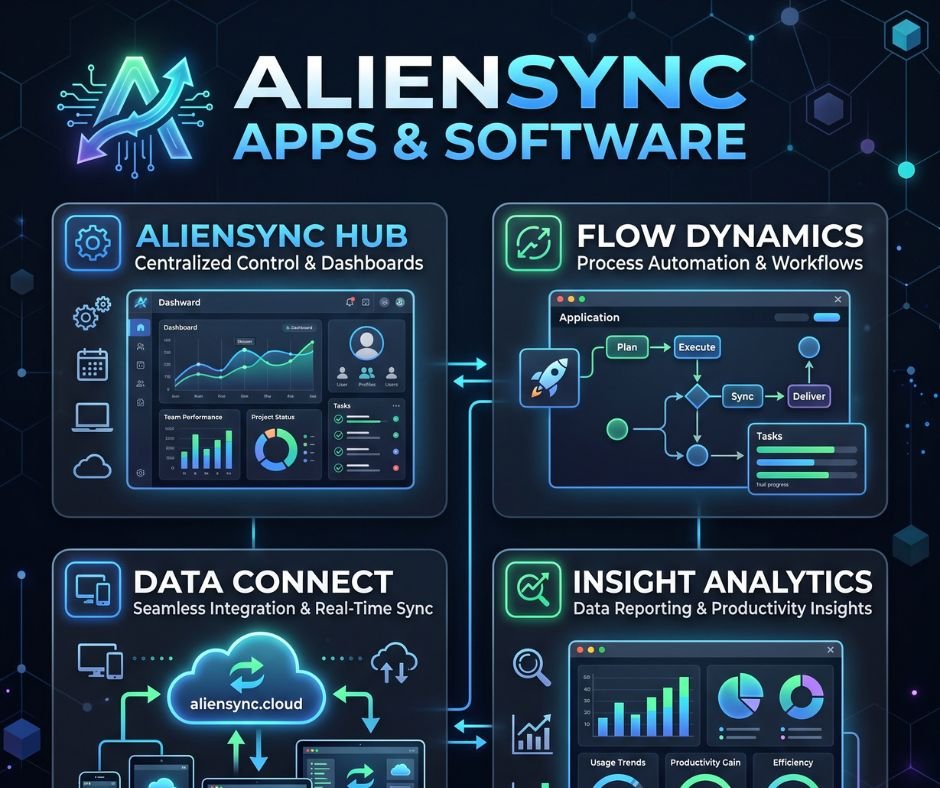
The features associated with AlienSync vary depending on which public description you examine. Some pages describe synchronization, workflow automation, dashboards, integrations, and centralized management. However, several of these capabilities are not independently documented through detailed public product specifications.
Therefore, it is better to evaluate Aliensync features as claimed capabilities or integration concepts unless you can confirm them through current first-party documentation.
App and Software Integration
The central idea behind Aliensync integration is connecting separate applications so they can participate in a common workflow.
Useful integration platforms generally support connectors, authentication methods, event triggers, actions, and data mapping. The quality of an integration depends heavily on the specific applications involved.
A platform might theoretically connect your CRM, cloud storage, communication tools, analytics system, and project-management software. Yet you should always check the current integration directory before assuming a particular service is supported.
Data Synchronization and Management
Synchronization can help keep related information aligned between applications. For example, an updated customer status might need to appear in several business systems.
Good synchronization also requires conflict management. If two applications modify the same record independently, the system needs rules for deciding which version takes priority.
This is why Aliensync data synchronization should not be understood simply as copying information. Reliable synchronization involves data mapping, timing, permissions, error handling, and monitoring.
Automation and Workflow Support
Aliensync automation is another commonly discussed concept. Workflow automation allows routine actions to happen when predefined conditions are met.
For example, a workflow could theoretically follow this pattern:
New lead received → Check lead information → Add contact → Notify sales team → Record activity
The real value comes from eliminating repetitive work without removing necessary human oversight.
What Apps and Software Can You Use With Aliensync?
Compatibility is one of the most important questions surrounding Aliensync applications. Unfortunately, current public information does not provide enough consistent documentation to treat a large list of third-party integrations as definitively supported.
Some online descriptions mention categories such as cloud services, project-management software, CRM systems, communication platforms, and social networks. Other pages mention individual applications. These claims should be checked against current first-party documentation before you connect an account.
Supported Apps and Platforms
When evaluating Aliensync compatibility, look beyond a simple list of logos. A useful integration directory should tell you what each connection actually supports.
For example, an integration might allow reading information but not writing it. Another could support one-way synchronization while a different connector supports two-way updates.
The distinction can completely change whether a platform fits your workflow.
Software Compatibility and Integrations
Compatibility can depend on more than the application name. You may need to consider:
| Compatibility factor | Why it matters |
| API access | Determines how applications exchange information |
| Authentication | Controls secure account access |
| Data format | Affects how information maps between systems |
| Permissions | Determines what the integration can access |
| Rate limits | Can restrict how frequently data moves |
| Webhooks | Enable event-based updates when available |
| Platform support | Determines whether desktop, web, or mobile workflows work |
This is especially important for businesses. A connection that works for a simple personal workflow may not satisfy enterprise requirements.
How to Get Started With Aliensync
Getting started with any synchronization platform requires more preparation than simply clicking a connect button. You should first identify the workflow you want to improve and determine which applications need to communicate.
This approach prevents unnecessary integrations. Instead of connecting every tool you use, begin with one repetitive process that has a clear outcome.
Requirements Before Getting Started
Before using an Aliensync system or any comparable integration service, check whether you have the necessary accounts and permissions.
You may need administrator access to business applications, API credentials, supported account types, or permission to install third-party integrations. Some organizations also require security approval before external applications can access business information.
You should also identify sensitive data before creating a workflow. Customer records, financial information, employee details, authentication credentials, and private documents deserve extra scrutiny.
Basic Aliensync Setup Process
The exact AlienSync setup process depends on the product and version you are using. Because publicly available product documentation is inconsistent, avoid following unofficial instructions that ask you to download unknown files or provide unnecessary credentials.
For a typical integration workflow, the process looks like this:
- Define the task you want to automate.
- Identify the applications involved.
- Verify official compatibility.
- Review permissions before connecting accounts.
- Authenticate each service through its normal login process.
- Map the required information between applications.
- Create a small test workflow.
- Check the results manually.
- Enable broader automation only after testing.
Testing first is particularly important when your workflow can modify or delete data.
Main Uses and Benefits of Aliensync
The potential value of Aliensync benefits comes from reducing fragmentation between applications. When your tools communicate effectively, you can spend less time transferring information manually and more time completing meaningful work.
However, automation should solve a real problem. Connecting applications simply because integration is possible can create unnecessary complexity.
Improving Productivity and Efficiency
Automation can reduce repetitive tasks such as transferring records, sending routine notifications, updating statuses, or organizing information.
Suppose a marketing team receives leads through an online form. A suitable workflow could automatically send each qualified lead to a CRM and notify the appropriate team member.
That does not replace the sales process. Instead, it removes administrative steps that provide little strategic value.
Reducing Repetitive Tasks
Repetitive digital work often appears harmless because each individual task takes only a few minutes. Over weeks and months, those minutes accumulate.
Productivity solutions can help when they eliminate predictable manual actions. The best candidates are tasks with clear rules and consistent inputs.
Tasks involving complex judgment should generally retain human review.
Aliensync for Businesses and Professional Workflows
Businesses often have more to gain from workflow management because employees repeat the same processes across many systems. Connecting those systems can potentially improve consistency and reduce administrative overhead.
Still, business automation requires stronger controls than casual personal automation. Security, permissions, auditability, data retention, and service reliability should all influence the decision.
Workflow Coordination
A well-designed workflow defines who owns each step and what happens next. For example, a new customer request could move from intake to assignment, review, communication, and completion.
Integration can automate transitions between those stages. Employees can then focus on decisions rather than repeatedly moving information from one application to another.
Team Productivity
Connected applications can reduce information silos. A project manager may need information from a CRM, while a marketing employee needs information from analytics and content systems.
A carefully designed integration can make relevant information available without requiring every employee to access every system.
That improves efficiency while preserving appropriate access boundaries.
Aliensync Security, Privacy, Compatibility & Common Problems
Security deserves careful attention whenever a service connects multiple accounts. Aliensync security should not be judged simply by marketing language such as “secure,” “encrypted,” or “enterprise-grade.”
The public information currently available across AlienSync properties does not provide enough consistent product-specific documentation to independently verify every security claim associated with the software concept. Some pages make broad security statements, while independent verification of certifications and detailed product controls is limited.
Is Aliensync Safe and Reliable?
There is no responsible way to declare an unfamiliar integration service completely safe without examining its current security architecture, permissions, documentation, ownership, data practices, and track record.
Before connecting an account, look for HTTPS, clear privacy documentation, appropriate authentication, transparent permissions, support information, and a way to revoke access.
For business use, you may also need evidence of security controls, data-processing practices, compliance requirements, logging, backup procedures, and incident-response processes.
Privacy and Data Considerations
Aliensync privacy is another area that deserves careful review. A website privacy policy is not necessarily the same thing as detailed documentation for a SaaS product processing connected business data.
Before sharing information, determine what data the service collects, why it collects it, how long it retains information, whether third parties receive it, and how you can delete or export your data.
Never provide sensitive information merely because an integration requests it.
Device and System Compatibility
Cross-platform compatibility depends on the actual software architecture. Web applications may work across operating systems through a browser, while desktop applications can have operating-system-specific requirements.
Mobile compatibility can also differ from desktop functionality. A service may offer account management on mobile without supporting every workflow feature.
Always verify the current requirements for your specific devices and applications.
Common Aliensync Problems
Synchronization systems can fail for ordinary technical reasons. Authentication tokens may expire, APIs may change, services can experience outages, or permissions can be revoked.
Other problems include incorrect field mapping, duplicate records, unsupported data types, rate limits, delayed updates, and workflows that trigger more frequently than expected.
A useful troubleshooting strategy starts with the simplest question: Did the trigger occur?
If the trigger worked, check the connection. Then inspect permissions, field mapping, destination settings, and error logs.
Aliensync Costs, Limitations, Mistakes & Alternatives

Cost is another area where you should rely on current first-party information rather than generic claims. Public AlienSync information does not provide sufficiently consistent pricing documentation to state a definitive subscription price. One current analysis also notes the absence of a clearly documented public pricing structure.
Is Aliensync Free or Paid?
Do not assume that AlienSync is free, paid, or freemium without checking the current official offering.
If a pricing page becomes available, compare more than the headline monthly price. Check usage limits, number of connected applications, automation runs, team seats, data-transfer limits, support, and premium features.
A low-cost plan can become expensive if your workflow volume grows quickly.
Potential Limitations to Consider
The biggest limitation at present is uncertainty surrounding the exact scope of the AlienSync product. Public descriptions differ significantly, making it difficult to treat every advertised capability as confirmed.
Integration platforms can also face general limitations such as connector availability, API restrictions, synchronization delays, permission requirements, and vendor-side changes.
Therefore, evaluate the exact workflow you need rather than choosing software based on a broad feature list.
Common Setup and Usage Mistakes
One common mistake is connecting too many applications before understanding the workflow. This increases complexity and makes errors harder to locate.
Another mistake involves granting excessive permissions. You should follow the principle of least privilege and provide only the access required for the intended task.
Finally, do not automate destructive actions before testing them. A mistaken rule can modify hundreds of records much faster than a human could.
Frequently Asked Questions
What is Apps and Softwares Aliensync?
Apps and Softwares Aliensync is an ambiguous term used online in connection with applications, software integration, synchronization, and technology content. AlienSync’s public web presence includes technology-focused content, while other pages describe it as an integration concept or platform.
What is Aliensync used for?
The term is commonly associated with connecting applications, synchronizing information, and improving digital workflows. However, specific product capabilities should be verified through current official documentation before use.
Is Aliensync free or paid?
Current public information does not establish a single, clearly documented pricing model. Check the provider’s current pricing information before purchasing or connecting business accounts.
Which apps does Aliensync support?
Public descriptions mention several software categories and integrations, but a consistently documented official integration directory is difficult to verify. Always confirm support for the exact application you need.
Is Aliensync safe to use?
Safety depends on the actual service, permissions, security controls, and data practices involved. Review privacy policies, authentication methods, permissions, security documentation, and account-access requirements before connecting sensitive information.
Final Thoughts
Apps and Softwares Aliensync sits at an interesting intersection of technology content, application integration, synchronization, and workflow automation. The underlying idea is valuable because modern users rarely work with one application in isolation.
However, the most important takeaway is to separate the concept of app integration from unverified claims about a specific AlienSync product. Current public sources describe AlienSync inconsistently, with its web presence clearly containing technology-focused content while other pages describe broader software and synchronization capabilities.

Welcome to DishVanta! I’m Jhone, a passionate content writer with 1 years of experience in SEO, digital content, and website growth. I create engaging, search-friendly content that helps websites attract more visitors and build a stronger online presence. My aim is to make SEO, content creation, and web design simple, practical, and effective. Let’s work together to create better content, grow your audience, and achieve lasting online success!